
27 people slept rough in Harlow in June, up from 10 a year earlier. The council's new action plan sets a target of zero long-term rough sleepers.
An estimated 27 people slept rough in Harlow at some point in June 2026. That is the highest monthly figure since the government’s records began in October 2020, and nearly three times the 10 recorded in June 2025.
The figures come from the Ministry of Housing, Communities and Local Government’s Rough Sleeping Data Framework, published on 27 August. They are built from Harlow Council’s own monthly returns.
Two days ago, on 3 November, the council adopted a new homelessness and rough sleeping action plan. One of its three targets is zero long-term rough sleepers. In June, by the government’s measure, Harlow had nine.
What the figures show
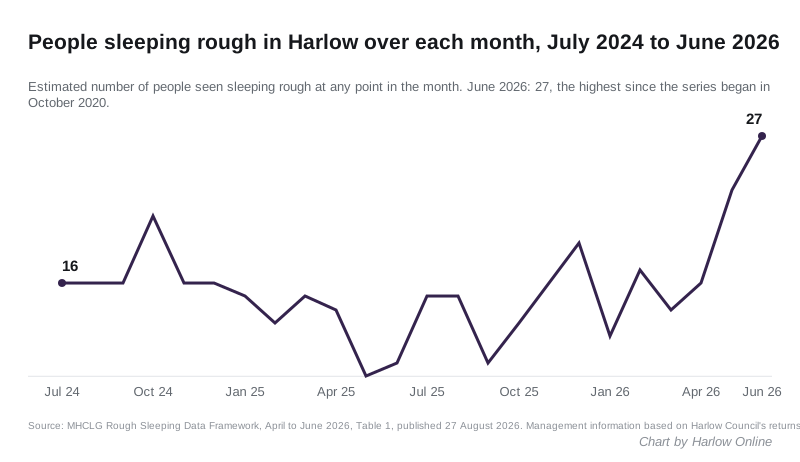
The monthly count is everyone seen sleeping rough in Harlow at any point in the month. For June 2026 the framework records:
| Measure | June 2026 | June 2025 |
|---|---|---|
| People sleeping rough over the month | 27 | 10 |
| Seen on a single night | 14 | 8 |
| Long-term rough sleepers | 9 | 7 |
| New to rough sleeping that month | 4 | 0 |
| Moved into accommodation that month | 2 | 0 |
The figure had already climbed to 23 in May. The previous peak in the series was 21, in January 2023, June 2023 and October 2024.
Of the 27 people in June, 24 were men and 3 were women, and 22 were UK nationals.
Long-term has a precise meaning here. It counts people seen sleeping rough in the month who have been seen sleeping rough in three or more of the last 12 months. Harlow’s figure was nine in both May and June 2026. (MHCLG, Rough Sleeping Data Framework tables, April to June 2026, Tables 1, 3, 5, 6, 15, 24 and 25)
The government describes these figures as management information and estimates, and they are revised if a council reports an error. Small numbers move a lot from month to month, so a single month is not a trend on its own.
How Harlow compares
Harlow is a town of about 98,500 people, so 27 is a rate of 27.4 per 100,000 residents for June. The framework puts England at 14.9 and the East of England at 12.7 for the same month.
The once-a-year autumn snapshot, a single-night count or estimate, points the same way. Harlow’s figure has risen every year since 2021:
- 2021: 0
- 2022: 4
- 2023: 7
- 2024: 13
- 2025: 16
The 2025 snapshot rate was 16.3 per 100,000 in Harlow, against 8.2 for England and 6.6 for the East of England. (MHCLG, Rough sleeping snapshot in England: autumn 2025, Tables 1 and 5)
The council’s new action plan
The plan was approved on 3 November by the council’s Deputy Leader and Portfolio Holder for Housing. It runs from September 2026 to September 2028. Councils must send one to the ministry by December, and the decision notice says that is a condition of homelessness grant funding. (Harlow Council decision, 3 November 2026)
It sets three targets:
- No families in bed and breakfast, other than for short emergency stays, and none for more than six weeks.
- Prevention above the national average. The plan quotes 46.5% as the national share of cases where a household’s homelessness duty ends with it securing a home.
- Zero long-term rough sleepers. The government’s own target is to halve the number. Harlow’s plan says “we will set our target at zero and strive to maintain it”.
Among the actions it lists, with their due dates:
- a move-on plan within two weeks for every household placed in temporary accommodation, from November 2026
- a review of referrals from prisons, hospitals and support agencies, by December 2026
- a review of the rent bond scheme, linked to the Renters’ Rights Act, by March 2027
- home visits for every eviction by parents, family or friends, by March 2028
- a first landlords forum to find more private rented homes, by March 2028
- a “No First Night Out” policy, to stop people reaching the streets at all, by March 2029
It also commits to continued support for Bromley Cottages with the Harlow charity Streets2Homes, and to a housing domestic abuse adviser in the council’s housing options team to cut the use of bed and breakfast for people fleeing abuse. (Homelessness Strategy Action Plan, September 2026 to September 2028)
The plan does not include any current Harlow figures for rough sleeping, temporary accommodation or bed and breakfast use. It says those measures will be reported quarterly from early 2027.
What it means for you
- If you are worried about someone sleeping rough, report it through StreetLink or on 03005 000 914. The council says StreetLink reports come to its team.
- Streets2Homes runs a day centre at 2 Wych Elm, CM20 1QP, open Monday to Friday from 9am to 2pm, with housing advice, food, clothing and washing facilities. Its number is 01279 430011. (Harlow Council, rough sleepers)
- If you have nowhere to stay tonight, call Harlow Council on 01279 446655.
- If you might lose your home in the next 56 days, fill in the council’s online homelessness assessment. A housing officer should call within five working days. (Harlow Council, help if you are homeless)
The next rough sleeping figures, for July to September 2026, are due on 26 November. The same day brings the quarterly temporary accommodation figures. We will add both here.
The council’s changes to who qualifies for its housing register are in our report on the allocations changes.
Sources
- MHCLG, Rough Sleeping Data Framework, April to June 2026, published 27 August 2026, data tables 1 to 25.
- MHCLG, Rough sleeping snapshot in England: autumn 2025, published 26 February 2026, tables 1 and 5.
- Harlow Council, decision on the Homelessness and Rough Sleeping Strategy Action Plan, 3 November 2026, and Appendix A, the action plan.
- Harlow Council, rough sleepers and help if you are homeless, checked 5 November 2026.
Have your say